[Blog](/blog/.md)
# Append-Only Object Storage: The Foundation Behind Cheap Bucket Forking
How immutable, append-only architecture enables O(1) snapshots and forks in Tigris object storage, inspired by ZFS and log-structured systems.
Authors
[](https://www.linkedin.com/in/ovaistariq/)
[Ovais Tariq](https://www.linkedin.com/in/ovaistariq/)
Co-Founder @ Tigris Data
[](https://www.linkedin.com/in/himank-chaudhary-1937b958/)
[Himank Chaudhary](https://www.linkedin.com/in/himank-chaudhary-1937b958/)
Co-Founder @ Tigris Data
Published2025-10-27
Reading8
min
Tags
[Engineering](/blog/tags/engineering/.md)[Architecture](/blog/tags/architecture/.md)
Contents
* [Introduction: The Log Is the Database](#introduction-the-log-is-the-database)
* [A Brief History of Immutability in Storage](#a-brief-history-of-immutability-in-storage)
* [Turning Object Storage Inside Out](#turning-object-storage-inside-out)
* [Append-Only Immutability: The Core Design](#append-only-immutability-the-core-design)
* [Why Append-Only Enables Cheap Snapshots](#why-append-only-enables-cheap-snapshots)
* [The Many-Worlds of Data: Snapshots and Forks](#the-many-worlds-of-data-snapshots-and-forks)
* [Why Forks Matter](#why-forks-matter)
* [Why This Matters for the Future of Storage](#why-this-matters-for-the-future-of-storage)
* [Conclusion: The Log Beneath the Cloud](#conclusion-the-log-beneath-the-cloud)
*Append-Only Object Storage: The Foundation Behind Cheap Bucket Forking*
## Introduction: The Log Is the Database[](#introduction-the-log-is-the-database "Direct link to Introduction: The Log Is the Database")
> "The log is the database; everything else is cache or materialized views."
That idea — echoed by Pat Helland, Jay Kreps, and [Martin Kleppmann](https://martin.kleppmann.com/2015/03/04/turning-the-database-inside-out.html) — captures a deep truth about modern systems: **immutability simplifies everything.**
In most databases, the log hides behind layers of mutable state. In Tigris, the object store *is* the log. Every write is an immutable event. Every snapshot is a bookmark in time.
Kleppmann wrote:
> "Databases are global, shared, mutable state … A more promising model … is to think of a database as an always-growing collection of immutable facts."
— [Turning the Database Inside Out, 2015](https://martin.kleppmann.com/2015/03/04/turning-the-database-inside-out.html)
That's the design philosophy behind Tigris — taking the principles of log-structured storage and applying them at the scale of cloud object stores.
Immutability turns time from a source of inconsistency into a controllable part of the design.
## A Brief History of Immutability in Storage[](#a-brief-history-of-immutability-in-storage "Direct link to A Brief History of Immutability in Storage")
Early filesystems and databases overwrote state in place. Safety mechanisms like write-ahead logs and journals were mere patches around mutable cores.
Then came the immutability revolution:
**NetApp WAFL (1990s)** — introduced copy-on-write inode trees, enabling instant snapshots.
**LVM - Logical Volume Manager (1998)** — extended the concept to block devices. LVM snapshots marked original data blocks as read-only and redirected writes elsewhere — implementing copy-on-write at the volume level. This made "instant rollback" possible long before distributed systems had it.
**ZFS (2004)** — elevated the model:
> "Everything is copy-on-write. Never overwrite live data."
— Jeff Bonwick, [ZFS: The Last Word in File Systems](https://pages.cs.wisc.edu/~dusseau/Classes/CS736/CS736-F13/Lectures/1_zfs_overview.pdf)
**Kafka, [Datomic](https://www.infoq.com/news/2012/04/datomic/), and [Samza](https://samza.apache.org/learn/documentation/latest/core-concepts/core-concepts.html) (2010s)** — brought the same idea to distributed data systems. Kafka reimagined the database log as a first-class citizen. Datomic treated data as immutable facts: nothing ever changes, only new truths are added. Samza showed that even computation could be modeled as functions over append-only logs.
Each of these systems — from block-level to distributed dataflow — reinforced the same insight: immutability makes systems simpler, safer, and more powerful.
Tigris borrows that lineage but lifts it one level up — from immutable blocks to immutable objects.
A personal note:
*Tigris' design is influenced by our time at Uber. We helped build Uber's global storage platform, scaling to hundreds of billions of requests daily. The append-only data model was central to the design of Uber's core trips data store [Schemaless](https://www.uber.com/blog/schemaless-part-one-mysql-datastore/).*
## Turning Object Storage Inside Out[](#turning-object-storage-inside-out "Direct link to Turning Object Storage Inside Out")
Traditional object stores treat buckets as mutable maps: you PUT, overwrite, DELETE — and history vanishes.
Even S3's "versioning" operates per object; it doesn't capture a consistent point-in-time view of an entire bucket. There's no concept of a *snapshot*.
Tigris flips that model. Every operation becomes an entry in an **append-only log**:
* Each `PUT` → a new immutable version
* Each `DELETE` → a tombstone
* Each snapshot → a **named cutoff in time**
No mutations, no in-place updates — only **immutable events indexed by time**.
Kleppmann summarized it perfectly:
> "What do we have to gain from turning the database inside out? Simpler code, better scalability, better robustness, lower latency."
— [Martin Kleppmann, Øredev 2015](https://martin.kleppmann.com/2015/11/05/database-inside-out-at-oredev.html)
With this design, object storage inherits the same architectural principles that once turned databases inside out.
## Append-Only Immutability: The Core Design[](#append-only-immutability-the-core-design "Direct link to Append-Only Immutability: The Core Design")
Under the hood, Tigris uses FoundationDB as a globally distributed, ordered key-value store that indexes every object version. Each object is represented as:
```
(bucket, object_key, version_epoch) → bytes
```
* **Writes are append-only.** A new version is always inserted; existing data is never modified.
* **Deletes are logical tombstones** that remain until all referencing snapshots are gone.
* **Reads return the newest version** ≤ snapshot timestamp.
To preserve descending chronological order, Tigris encodes timestamps as **negative Unix epochs**, taking advantage of FoundationDB's lexicographic key ordering. This ensures the newest version of each object naturally appears first in a regular forward range scan.
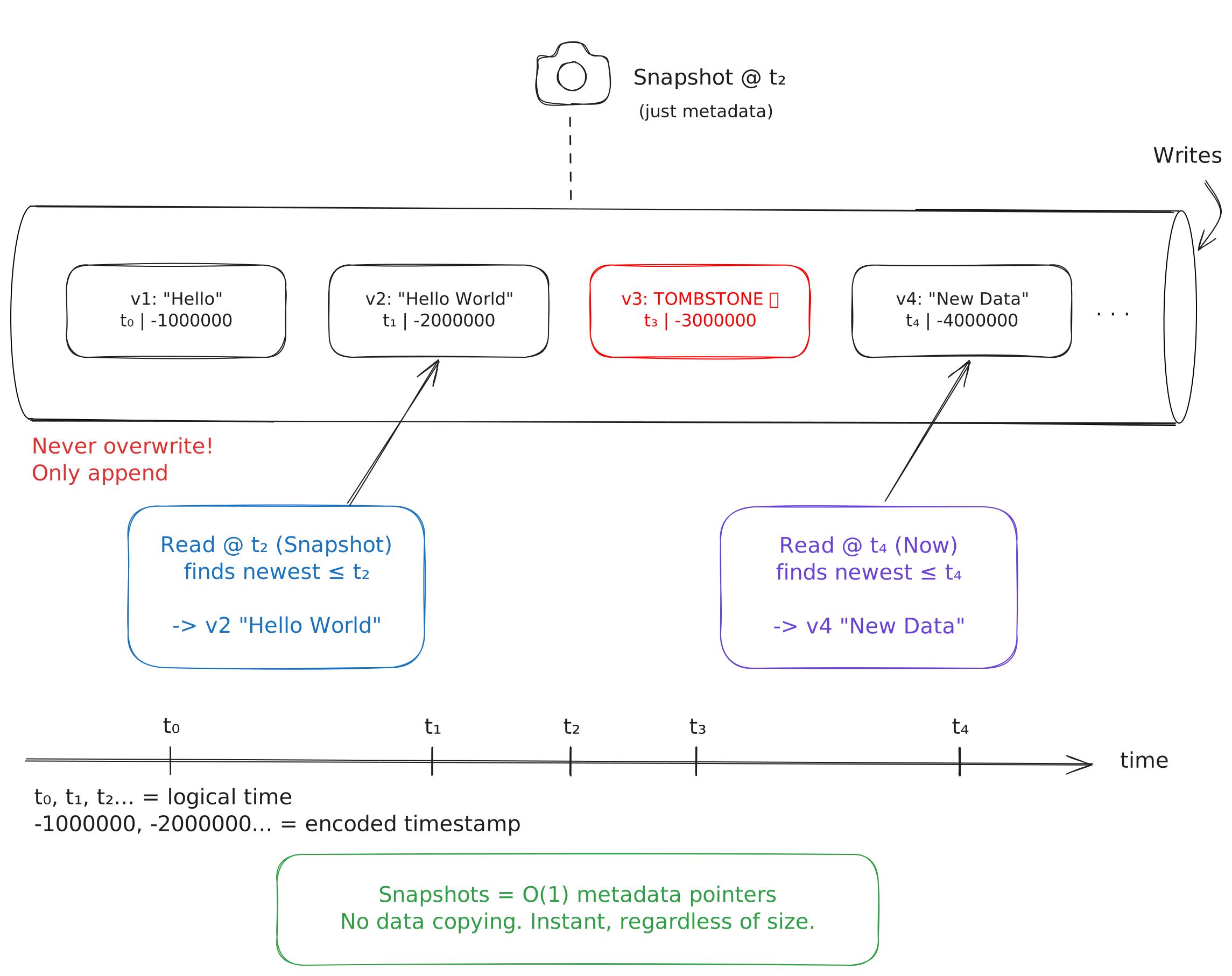
When you take a snapshot, it's just a metadata entry — a timestamp cutoff that defines a consistent read boundary.
Snapshots require no data copies or scans — just a metadata pointer defining a consistent view.
Snapshots are effectively **O(1)** metadata operations — their cost depends on metadata, not data size.
As ZFS itself claims:
> "Actually cheaper to take a snapshot than not! Constant-Time Snapshots."
— [ZFS: The Last Word in File Systems](https://pages.cs.wisc.edu/~dusseau/Classes/CS736/CS736-F13/Lectures/1_zfs_overview.pdf)
Even massive buckets can be snapshotted or forked almost instantly, since only metadata changes.
## Why Append-Only Enables Cheap Snapshots[](#why-append-only-enables-cheap-snapshots "Direct link to Why Append-Only Enables Cheap Snapshots")
Mutable systems pay O(N) in copying or diffing to simulate immutability. Append-only systems pay O(1): snapshots are just **timestamps** over an immutable log.
| Operation | Mutable Storage | Append-Only Storage |
| ----------------- | --------------- | ------------------- |
| Snapshot creation | Deep copy | Metadata write |
| Restore | Re-copy | Flip pointer |
| Consistency | Lock-based | Version-based |
| GC safety | Risky | Reference-counted |
ZFS pioneered this model: *"Never overwrite live data."* ([ZFS Presentation, UT Austin](https://www.cs.utexas.edu/~dahlin/Classes/GradOS/papers/zfs_lc_preso.pdf))
Tigris inherits it — but distributes it globally, at the object layer.
Instead of ZFS's block-level **deadlists** — see [Ahrens, *How ZFS Snapshots Really Work*](https://papers.freebsd.org/2019/BSDCan/ahrens-How_ZFS_Snapshots_Really_Work.files/ahrens-How_ZFS_Snapshots_Really_Work.pdf), Tigris tracks object version references across snapshots and forks. Old versions are garbage-collected only after every referencing snapshot has expired — mirroring ZFS's deadlist semantics at internet scale.
## The Many-Worlds of Data: Snapshots and Forks[](#the-many-worlds-of-data-snapshots-and-forks "Direct link to The Many-Worlds of Data: Snapshots and Forks")
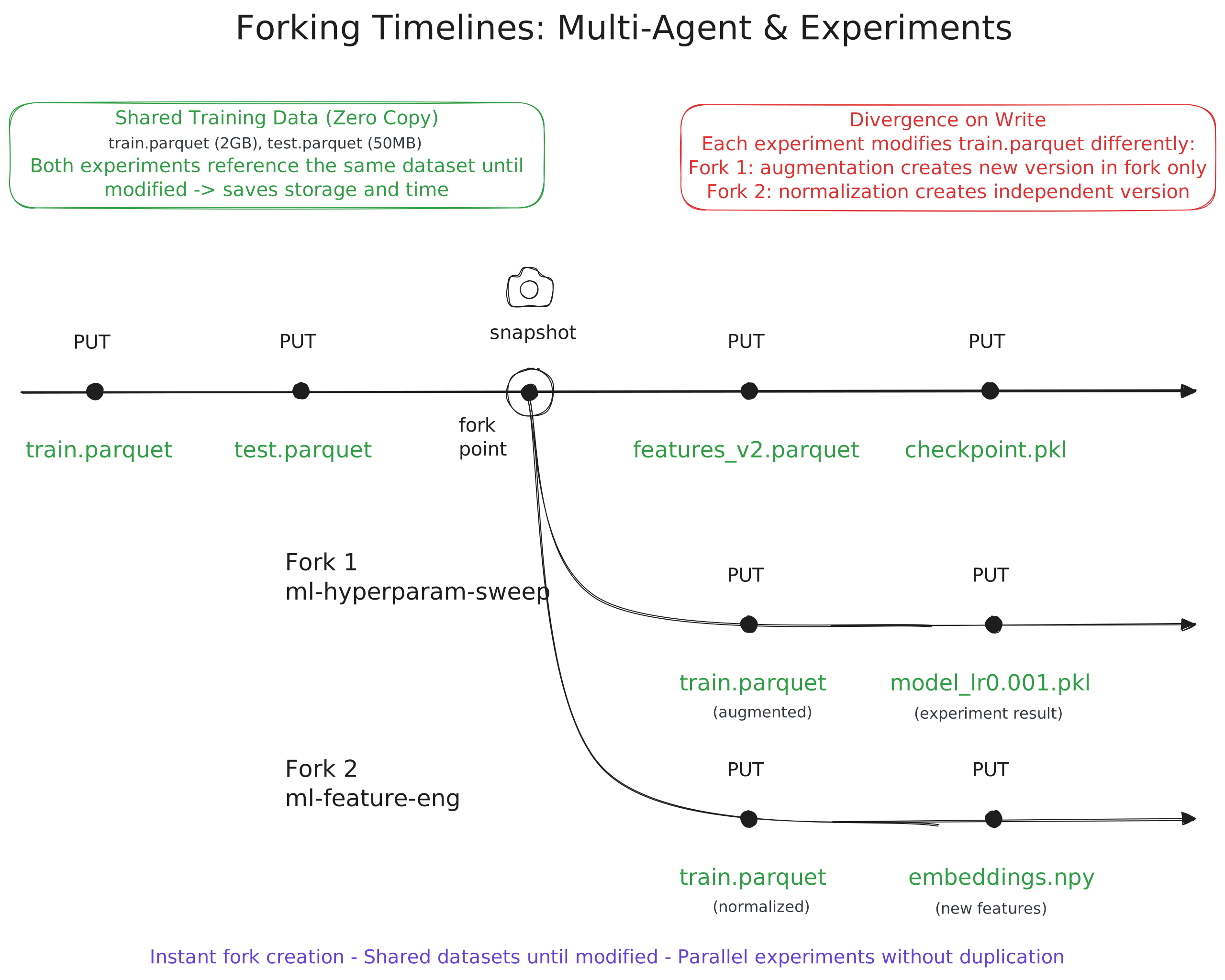
Each snapshot freezes the world at a moment in time. A **fork** spawns a new, parallel timeline.
**ZFS:**
```
zfs snapshot tank/data@t0
zfs clone tank/data@t0 tank/data-dev
```
**Tigris:**
```
from tigris_boto3_ext import (
create_fork,
)
# Fork from the latest state of a bucket
create_fork(
s3_client,
"llm-fork-snap",
"llm-base"
)
```
Or if you want to fork from a specific snapshot:
```
from tigris_boto3_ext import (
create_snapshot,
get_snapshot_version,
create_fork,
)
# Fork from a specific snapshot
result = create_snapshot(
s3_client,
"llm-base",
snapshot_name='pre-finetune' # optional name for the snapshot
)
snapshot_version = get_snapshot_version(result)
create_fork(
s3_client,
"llm-fork-snap",
"llm-base",
snapshot_version=snapshot_version
)
```
Forks share all unchanged data with their parent, but diverge lazily on writes. It follows the same branching model that Git made familiar.
## Why Forks Matter[](#why-forks-matter "Direct link to Why Forks Matter")
Forks and snapshots bring **data version control** to object storage — something the ecosystem has long lacked. Unlike external catalog systems or overlays, versioning is native to Tigris's storage layer.
* **Reproducibility**: Point-in-time datasets guarantee reproducible ML training and analytics.
* **Safe Experimentation**: Fork a production bucket, run transformations, discard it — the production data stays pristine.
* **Multi-Agent AI Workflows**: Each agent gets its own forked universe, all derived from the same snapshot baseline. Agents can process, train, and mutate independently without collision.
* **Auditing & Recovery**: Immutable snapshots form a verifiable audit trail. Forks can restore state instantly after errors.
## Why This Matters for the Future of Storage[](#why-this-matters-for-the-future-of-storage "Direct link to Why This Matters for the Future of Storage")
Every generation has made one architectural bet: **treat changes as immutable facts**.
| Era | Innovation | Principle |
| ----- | --------------- | -------------------------- |
| 1990s | WAFL | Copy-on-write filesystem |
| 2000s | ZFS | Transactional CoW blocks |
| 2010s | Kafka / Datomic | Logs as systems of record |
| 2020s | Tigris | Append-only object storage |
Tigris extends that principle to the cloud's most fundamental layer: object storage.
Snapshots, forks, and time-travel are implemented as primitives, not layered abstractions.
Tigris combines the durability of ZFS, the branching semantics of Git, and the scalability of S3 — in a single, consistent storage model.
## Conclusion: The Log Beneath the Cloud[](#conclusion-the-log-beneath-the-cloud "Direct link to Conclusion: The Log Beneath the Cloud")
> "The log is the database. Everything else — indexes, forks, views — are just materialized projections of it."
That's Tigris: a distributed object store where immutability isn't an afterthought — it's the architecture.
If you care about immutability and version control at the storage layer, **try bucket snapshots and forks in Tigris** — and see what happens when your object store really becomes your source of truth.
Experience Inside-Out Object Storage
Ready to try immutable snapshots and forks?
[Check out the docs](https://www.tigrisdata.com/docs/buckets/snapshots-and-forks/)
## Share
[X](https://twitter.com/intent/tweet?text=Check%20out%20this%20post%20on%20the%20%40tigrisdata%20blog%3A%20Append-Only%20Object%20Storage%3A%20The%20Foundation%20Behind%20Cheap%20Bucket%20Forking%0A%0A\&url=https%3A%2F%2Fwww.tigrisdata.com%2Fblog%2Fappend-only-storage)[Hacker News](https://news.ycombinator.com/submitlink?u=https%3A%2F%2Fwww.tigrisdata.com%2Fblog%2Fappend-only-storage\&t=Append-Only%20Object%20Storage%3A%20The%20Foundation%20Behind%20Cheap%20Bucket%20Forking)[LinkedIn](https://www.linkedin.com/sharing/share-offsite/?url=https%3A%2F%2Fwww.tigrisdata.com%2Fblog%2Fappend-only-storage)[Email](mailto:?subject=Append-Only%20Object%20Storage%3A%20The%20Foundation%20Behind%20Cheap%20Bucket%20Forking\&body=Hey!%0A%0ACheck%20out%20this%20article%20on%20the%20Tigris%20blog%3A%20https%3A%2F%2Fwww.tigrisdata.com%2Fblog%2Fappend-only-storage)Copy link