Bucket snapshots are git tags for your bucket



Whole bucket snapshots, like git tags for your bucket
Sometimes you wish you could go back in time with your data after things go wrong. Say the incorrect data got deleted, or your model started promising to sell a car for $1 and you need to figure out which data led to that unexpected behavior. Can you go back in time to see how things were so you can figure out where it all went wrong? Snapshots enable this– they've been a core component of resilient system design since the 60s, and they're finally making it to object storage.
With Tigris, you can snapshot a point in time for your whole bucket. Not just
individual object versions. The same way you'd git tag a release, you can name
your snapshot with a meaningful version and reference it from other tools. And a
snapshot can seed a
fork, an instant,
isolated copy of a bucket. As far as we can tell, Tigris is the only object
storage system to offer this as a feature.
Why snapshots matter
Object storage has been thought of as a backup target– databases, VMs, volumes, registries, and even entire datacenters can be snapshotted and backed up to object storage. But what about snapshotting object storage itself? More and more systems, especially cloud native ones, use object storage as the primary data store. It's simpler, and it fits the shape of the data: increasingly unstructured and multi modal.
If object storage is the primary data store, it needs safety features like snapshots. S3's object versioning got us close, but recovery and versioning are limited to single objects. Stitching together the state of a bucket at a point in time has required touching each object and hoping for consistency. It takes a whole bucket snapshot to provide reproducibility, version control, and insurance against mistakes.
Version control built directly into object storage
Here's what's cool: snapshots work for datasets that don't fit into existing data version management tools. Think of extremely large, frequently changing datasets such as:
- Raw clickstreams
- Event logs
- Batch-appended training logs
- Video streams
- Kafka message streams
- Real time inference logs
Anything that's large and changes frequently is tough for traditional tools to version. And we as an industry are increasingly feeding live data into our systems in a way that can meaningfully change the outputs of our models.
It's lightweight version control for all of your data.
Whole environments, cloned instantly
Developer sandboxes, AI agent environments, load testing with real production data, feature-branch test environments– all of these spin up faster and more consistently from a snapshot.
Need to experiment on massive datasets without the risk of hurting the data if things go wrong? Put it in a bucket and fork it. Many digital hands make light work!
Want to spin up an instance of an AI agent quickly? Store all its dependencies in a snapshot, and make a forked bucket from the snapshot on launch. Your agent has everything it needs without moving data around.
How to use snapshots
You can create a snapshot enabled bucket in the Tigris Console, and then create a snapshot in it.
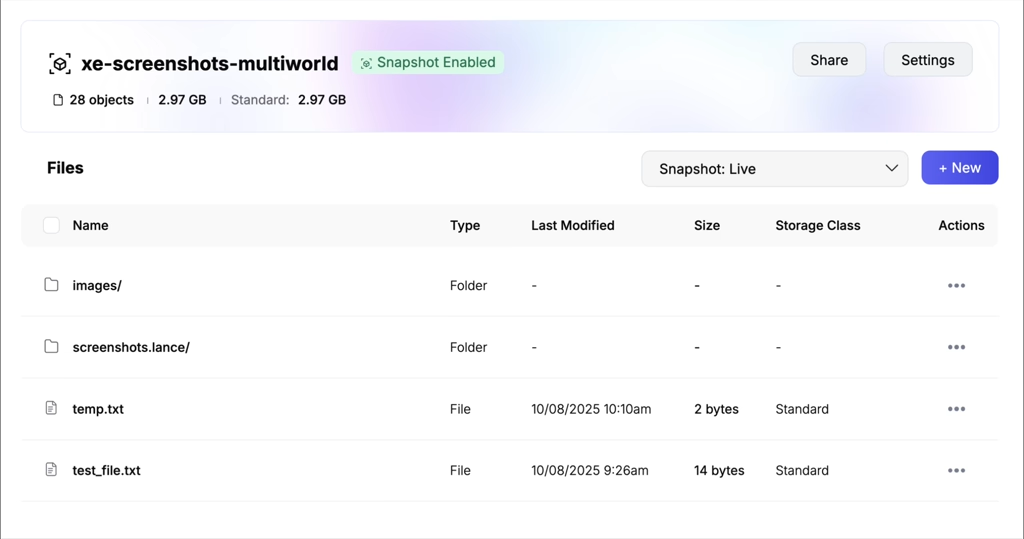
You can also do this from the Tigris SDK for JavaScript and TypeScript:
import { createBucketSnapshot } from "@tigrisdata/storage";

const { data, error } = await createBucketSnapshot();

if (error) {
  console.error("Error creating snapshot:", error);
} else {
  console.log("Snapshot created:", data);
  // output: { snapshotVersion: "1751631910169675092" }
}
Conclusion
Snapshots have been around since the 60s. The first snapshots were for the CPU registers, memory, and device state of mainframes. And then in the 80s, database checkpoints enabled atomic rollbacks and crash recovery. In the 90s, we got filesystem level snapshots with ZFS and LVM. And then in the 2000s with the rise of virtualization, we adopted snapshotting at the image layer. But we haven't had object storage level snapshots until now.
Whole bucket snapshots are a big deal because they extend snapshot semantics, normally limited to filesystems, block volumes, or individual objects, to an entire object storage namespace. The functionality is similar to what's come before, but the way it's implemented is new. Read more in the deep dive on how we built snapshots. Spoiler: snapshots are essentially free because Tigris uses an append only log.
Get your entire bucket of objects, all versioned together. Only on Tigris.
Try Bucket Snapshots
Ready to add version control to your object storage? Get started with snapshots in Tigris.